Module 1: Understanding AI-native solutions for finance
Objective: Introduce CFOs to the concept of AI-first finance, detailing its transformative potential, and specifying the key attributes that define a genuinely AI-native platform.
Key takeaways:
AI-native finance is a shift in how tasks are automated and how decisions are made. It moves finance from manual, retrospective work to continuous, insight-driven, and proactive decision-making embedded directly into daily workflows.
The real value comes from redesigning workflows around AI. AI-native platforms treat data as a living asset, power end-to-end processes, and adapt in real time, unlike AI-enabled tools that remain dependent on manual oversight.
When governed properly, AI strengthens financial control rather than weakening it. With embedded guardrails, validation, and monitoring, AI improves risk detection, transparency, and consistency while reducing human error and operational strain.
Finance teams gain leverage. AI handles scale, speed, and pattern detection; humans focus on judgment, strategy, and business impact. Roles evolve toward higher-value analysis and leadership.
In volatile environments, AI-native finance becomes a competitive advantage. Real-time visibility, early risk signals, and adaptive forecasting allow organizations to move faster, protect liquidity, and act with confidence when conditions change.
What does “AI-native” mean in a financial context
AI-native finance is the use of AI to transform how finance teams operate and decide: automated instead of manual, insight-driven instead of guesswork, proactive instead of reactive. AI can automate routine work, deepen analysis, and shift teams from manually processing data to generating strategic insight and value.
The result is a redefinition of finance roles and workflows: faster execution, better decisions with less stress, stronger risk management, and more time focused on what actually moves the business forward.
Here are a few examples of how various roles in the finance department benefit from becoming AI-native:
CFO
Focus shift: From overseeing reporting/cost control to formulating proactive corporate strategy, identifying new revenue streams, optimizing capital allocation, and guiding digital investments.
Treasurer
Focus shift: From manually managing bank accounts and short-term debt to optimizing liquidity and working capital and mitigating financial risk.
Controller
Focus shift: From manual general ledger reconciliation and report generation to governing automated real-time processes like reconciliation, forecasting and reporting.
Accounts Payable/Receivable Specialist
Focus shift: From manual invoice processing, matching purchase orders, and chasing payments to monitoring the AI workflow and resolving complex exceptions.
FP&A Analyst
Focus shift: From time-consuming data collection and manual forecast modeling to analyzing AI-generated forecasts, simulating complex scenarios, and driving business partnerships.
Differences between AI-enabled vs. AI-native tools
AI-native solutions were designed and built from the ground up with AI as their foundational, core technology. AI is not just an add-on or a feature layered onto existing traditional systems. It is the intrinsic engine that powers the business model, operations, and customer experience.
AI-Native vs. AI-First
AI-Native
AI-Enabled
Design
AI is built into the core architecture from day one
AI is incorporated or patched on into existing products or workflows
Operations
AI models power end-to-end workflows and continuous decision-making
AI often serves as a pilot program or limited tool for specific tasks
Data strategy
Data infrastructure is an active system optimized for continuous inference. Data is the most valuable asset.
Data is primarily a record-keeping system; AI utilizes a subset of this data
Processes
All new processes and products are conceived with an AI-first mindset
Existing processes are digitized or automated with AI to improve efficiency
Risk management
AI evaluates uncertainty, data quality, bias, drift, and downstream impact in real time, with guardrails and controls embedded into decision flows
Controls are largely manual or policy-driven, with AI outputs reviewed periodically and risk assessments handled outside the core workflow
Technology stack
Built on modern, scalable infrastructure (e.g., cloud-native, MLOps, real-time data pipelines).
Often involves retrofitting AI onto legacy systems.
Adaptation
Systems are designed for continuous learning and real-time adaptation based on new data
Learning cycles are typically slower, reliant on periodic updates
Real-World Examples of AI-Native Finance in Action
Later on in this course we’ll dive into practical examples and use of AI-native finance. For now, here’s a taste of a few scenarios where AI-native finance can make an impact in daily finance workflows.
Example 1: Transforming raw data into actionable guidance
AI brings intelligent automation to treasurers by turning raw financial data into clear, actionable guidance.
For example, a treasury team receives cash-flow data from dozens of bank accounts every day. Instead of manually reviewing spreadsheets, an AI system analyzes all inflows and outflows in real time, highlights unusual movements, and recommends actions. These could be adjusting short-term investments or preparing for a liquidity gap later in the week.
Example 2: Spotting patterns and forecasting outcomes
AI models learn from historical data to spot patterns, forecast outcomes, and identify behavior, without needing hard-coded rules or manual thresholds.
For example, ML models power real-time anomaly detection in cash movements. The model understands “normal” patterns across accounts and flags unusual inflows, outflows, or timing anomalies before they become risks.
Example 3: Interpreting context and generating scenarios and recommendations
GenAI can interpret context, summarize information, and generate new content, like scenarios, narratives, insights, or recommendations.
For example, LLMs can generate automated multi-path cash forecasting. GenAI produces several scenario narratives with pros, cons, and risk insights tailored to current liquidity conditions.
Example 4: Intelligent agents
AI agents act as autonomous assistants for treasury. They can monitor data, apply policies, trigger workflows, and escalate risks in real time.
For example, a liquidity agent that continuously scans positions, compares them to policy thresholds, alerts the team when buffers tighten, and automatically prepares transfer recommendations.
Risks and Rewards
Adopting AI-native finance is not a neutral technology upgrade. It reshapes how decisions are made, how accountability works, and how risk is managed. When AI risks are clearly understood and properly governed, the rewards consistently outweigh the risks.
This section briefly covers risks to address. We dive deeper into the risks and mitigation strategies in Module 3.
Agentic AI hallucinations - Generative models sometimes invent facts with confidence. In a financial context, this could mean fabricated numbers in a forecast or incorrect regulatory references in a filing.
Data leakage - Sensitive M&A, client, or treasury data can “leak” into AI tools if guardrails are weak. Once exposed, private information may become part of training data or resurface in other queries.
Privacy and regulatory compliance - Mishandling customer data or PII exposes companies to fines, audits, and reputational harm under frameworks like SOC2 and GDPR.
Trust boundaries and governance - Weak access controls or prompt injection attacks can allow users or malicious actors to bypass permissions. This could expose broader data than intended or trigger unauthorized actions.
MCP weaknesses - Without strong validation and monitoring, MCP servers could inject false context into models. This manipulation can lead LLMs to produce harmful or misleading outputs.
Strategic Advantages of Using AI in Finance
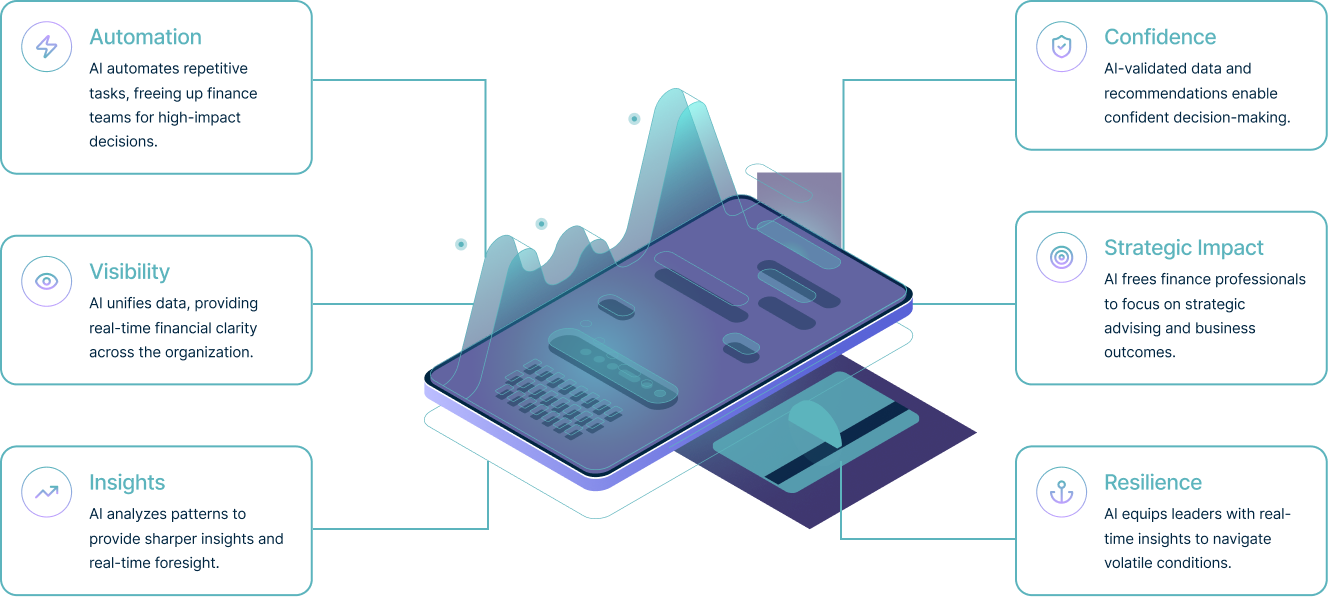
Forward thinking finance teams embed AI directly into financial workflows, allowing them to:
Replace manual work with AI automation - AI automates time-consuming, repetitive tasks such as transaction categorization, reconciliations, forecasting, and reporting. Instead of spending hours preparing data, finance teams can rely on continuous, automated processing that runs in the background. The result is faster cycles, fewer errors, and more capacity to focus on judgment-driven, high-impact decisions.
Gain real-time financial visibility and clarity - AI-native platforms unify and validate data across banks, ERPs, subsidiaries, and entities into a single, continuously updated source of truth. This eliminates data silos, manual consolidation, and version conflicts. Finance leaders gain an accurate, real-time view of cash positions, exposures, and obligations across the entire organization, at any moment. This allows them to make better decisions with greater confidence, especially in complex, volatile environments.
Come up with sharper insights and real-time foresight - AI goes beyond reporting what happened by continuously analyzing patterns, anomalies, and trends as they emerge. It surfaces early signals of liquidity risks, funding gaps, or growth opportunities before they become urgent. This shift from hindsight to foresight allows finance teams to act proactively instead of reacting under pressure.
Make decisions confidently - With validated data, contextual recommendations, and end-to-end visibility, CFOs and treasury teams can make decisions with greater speed and confidence. AI continuously monitors liquidity, flags emerging risks, and prioritizes the insights that matter most, helping leaders avoid surprises and respond decisively when conditions change.
Make a higher strategic impact - By removing operational clutter, AI frees finance professionals to focus on what humans do best: analysis, scenario planning, strategic advising, and influencing business outcomes. Finance evolves from a reporting function into a true strategic partner to the business, shaping growth, investment, and risk decisions.
Build resilience in volatile conditions - In uncertain markets, speed and clarity matter. AI-native finance equips leaders with real-time insight, adaptive forecasting, and rapid scenario modeling, enabling them to safeguard liquidity, manage risk, and seize opportunities even as conditions shift. This resilience turns volatility from a threat into a competitive advantage.
Benefits of AI in Finance
Learn more about the ROI of AI-native finance in Module 5.
FAQs
1. Is AI-native finance just automation with a new label?
No. Automation digitizes existing processes. AI-native finance redesigns workflows around intelligence. Instead of simply speeding up manual steps, AI continuously analyzes data, generates insights, adapts forecasts, and supports real-time decision-making across workflows.
2. How is AI-native different from adding AI features to an ERP or treasury system?
AI-enabled systems bolt intelligence onto legacy infrastructure. AI-native platforms are architected around continuous learning, inference, and adaptive workflows from day one. The difference shows up in real-time vs. batch processing, continuous learning vs. periodic updates, embedded risk controls vs. external oversight, and end-to-end workflow intelligence vs. point solutions
3. What are the biggest risks CFOs should monitor?
Key risks include hallucinated outputs from generative models, data leakage into external AI tools, model bias and drift, weak access controls or prompt injection, and degulatory compliance gaps. Mitigation requires governance frameworks, audit trails, model validation, and strict data boundaries.
4. What does success look like in an AI-native finance function?
You’ll know you’re there when reporting is continuous, not periodic, forecasts adapt in real time, exceptions are flagged automatically, decision-makers receive guidance, not just data, and finance operates as a strategic growth partner. At that point, finance is no longer reacting to the business. It is actively steering it.
5. How does Panax fit into the AI-native finance model?
Panax is an AI-native treasury and cash management platform and not a legacy system with AI bolted on. It continuously connects to banks and ERPs, validates data, runs intelligent models, and delivers real-time liquidity insights, anomaly detection, forecasting, and scenario analysis through continuous inference. Governance is built in by design. Guardrails, policy thresholds, validation logic, and full auditability are embedded into workflows so AI reinforces financial control. In practice, Panax shifts finance teams from reactive cash tracking to proactive liquidity strategy, transforming treasury into a forward-looking decision engine.
Next lesson
Mastering prompts for the CFO’s toolkit
Learn secure, effective GenAI prompts, distinguish public vs. private use & turn financial context into actionable insights across forecasting, liquidity, risk, etc.




.webp)


